

Many businesses believe they already understand their customers because they see reviews, read support emails, and hear comments during sales calls. That kind of feedback is useful, but it is usually fragmented. It reflects isolated moments, not a structured picture.
That becomes a problem when the business needs to make decisions about pricing, messaging, service quality, customer satisfaction, product ideas, or website improvements. Informal feedback may highlight symptoms, but it rarely shows patterns clearly enough to support confident action.
This is where online research tools become valuable. They help businesses move from scattered opinions to organized responses, making it easier to identify trends, compare answers, and understand what customers or employees are actually saying at scale.
What Businesses Need From Online Surveys Today
A useful survey tool needs to do more than collect answers in a basic form. Businesses often need to run customer feedback surveys, satisfaction tracking, market research, employee surveys, product evaluations, or idea testing. They also need a way to share surveys easily, analyze results, and turn responses into something actionable.
That means a practical survey platform should support flexible publishing, clear reporting, and enough customization to fit different research goals. If a company wants to test customer sentiment, compare multiple options, or gather feedback after a purchase, the tool should make that process simple rather than technical.
The best tools also fit naturally into existing business websites and workflows. A survey should not feel like a separate disconnected project. It should work as part of the business’s broader research and customer insight process.
Why General-Purpose Forms Often Fall Short
Generic forms can collect names, emails, and simple answers, but they are often too limited when a business wants real research value. They may work for basic inquiries, but they are less effective when the goal is to run structured surveys, compare response paths, or analyze results in a more meaningful way.
Research-focused surveys usually need more than a few text fields and checkboxes. Businesses often benefit from conditional logic, a wider range of question formats, publishing flexibility, export options, and built-in analytics. Those features matter because they make the results easier to interpret and the survey itself easier for users to complete.
That is why dedicated survey tools usually make more sense than adapting a simple form builder. They are designed for feedback, research, and testing workflows from the beginning.
What to Look for in a Practical Survey Tool
A practical online research tool should help with four things: building, publishing, analyzing, and sharing results.
First, it should be easy to build surveys without technical effort. A no-code builder, templates, and a user-friendly editor make a big difference for teams that want to launch quickly. SurveyNinja, for example, positions itself as a no-code survey builder with templates, a drag-and-drop style editor, and customizable survey elements.
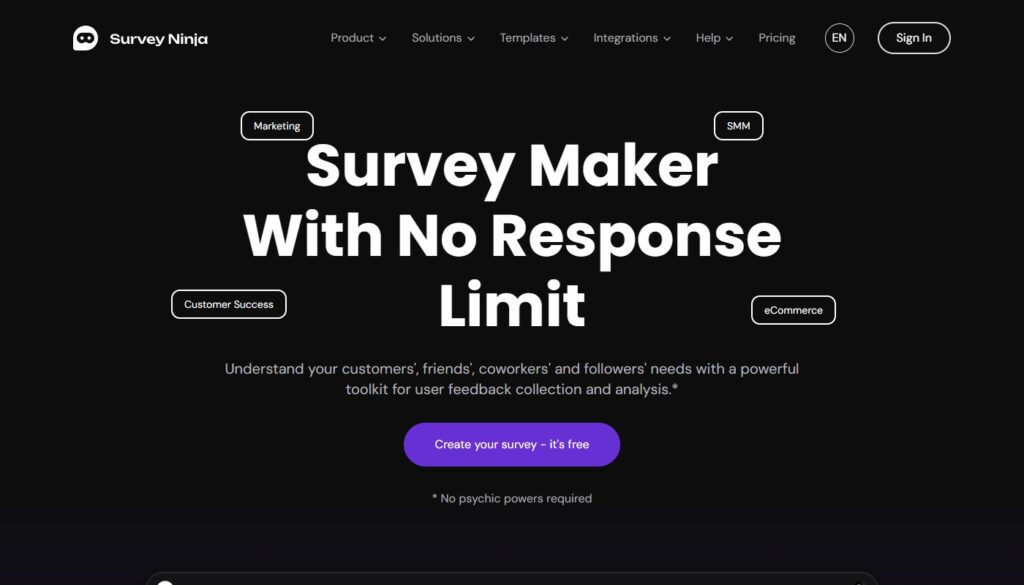
Second, it should support multiple ways to publish surveys. Businesses may want to send a survey by link, place it on a website, distribute it through a QR code, or even print it for offline use. SurveyNinja specifically says surveys can be shared by link or QR code, printed, or embedded into a site.
Third, the tool should make analysis practical. Built-in analytics, visual reporting, and export options are important because collecting responses is only the first half of the process. SurveyNinja highlights built-in analytics and export, along with downloadable results in PDF, CSV, or XLSX.
Fourth, it should support team use. If multiple people need to review responses or collaborate on research, shared access becomes important. SurveyNinja also promotes team collaboration and result sharing as part of its platform.
How Dedicated Survey Platforms Support Real Business Research
Dedicated survey tools are useful because they support more than one kind of business question. A company may want customer feedback this month, employee input next month, and market research before a launch after that. A stronger survey platform can support all of those use cases without forcing the team to start over each time.
SurveyNinja presents itself around a broad set of business uses, including customer feedback, CSAT, NPS tracking, churn surveys, market research, UX testing, post-purchase surveys, employee engagement, and product or service evaluation. It also offers integrations such as Google Analytics, Google Sheets, HubSpot, Salesforce, Slack, Zapier, Airtable, Telegram, Meta Pixel, and webhooks.
That matters because online research is rarely a one-time task. Businesses need tools that can grow with different teams and different goals, from customer experience and marketing to HR and product decisions.
Why SurveyNinja Fits Naturally Into Business Websites
A business website should not only present services. It can also collect feedback, validate ideas, and support research. That is one reason embedded surveys are so useful. They allow businesses to ask questions directly in the environment where visitors already interact with the brand.
SurveyNinja is a practical example here because it supports site embedding as part of its publishing model. That makes it easier to turn a standard website into a research channel without custom development. A company can place a survey on a relevant page, collect feedback during or after a user journey, and then analyze the results inside the same platform.
This is often a better approach than relying only on occasional feedback forms. A dedicated survey embedded on the site can support campaign testing, service evaluation, idea validation, or customer satisfaction work in a more focused way.
From Feedback Collection to Better Decisions
The real value of online surveys is not in the form itself. It is in what the business learns and how quickly it can act on that information.
When businesses use stronger research tools, they can ask better questions, structure responses more clearly, and analyze patterns with less guesswork. They can compare customer opinions, test assumptions before investing, and reduce the risk of making changes based only on internal opinion.
That is the strongest case for better online research tools. They make feedback more usable. And when a platform combines no-code building, templates, flexible publishing, embedded surveys, analytics, export, and integrations, it becomes much easier to treat research as an ongoing business function rather than an occasional one. SurveyNinja is one example of that kind of platform.