
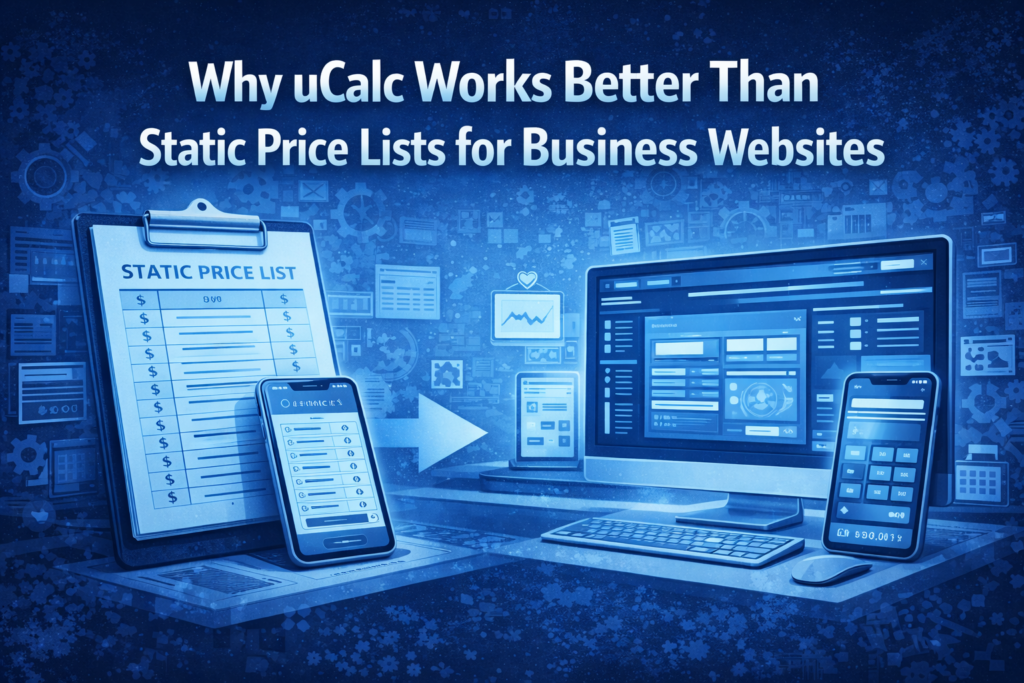
A static price list may look simple, but for many business websites it creates more confusion than clarity. Most service businesses do not work with one fixed number. Pricing often depends on quantity, size, urgency, add-ons, delivery, service type, or project complexity.
That is where traditional price tables start to fail. They show isolated numbers, but they do not help customers understand what applies to their situation. As a result, visitors are left guessing, comparing the wrong options, or sending basic pricing questions that the website should have answered on its own.
If the goal of a business website is to make the buying process easier, a static price list is often too limited. Businesses need something more flexible, more informative, and more useful. That is exactly where uCalc becomes a better option.
What Makes uCalc a Better Alternative
uCalc is built specifically for creating online calculators and forms for business websites. It is positioned as a no-code builder that lets companies create calculators themselves in a short time, using ready-made templates or starting from scratch in a visual editor.
Instead of showing customers a fixed table, uCalc allows a business to create an interactive experience. Visitors can choose options, enter values, compare scenarios, and receive a more relevant estimate based on their actual needs. That makes pricing easier to understand and much more useful than a generic list of numbers.
This is the core reason uCalc stands out: it is not just a form tool with a few extra fields. It is a service designed around business calculators, estimates, quote flows, and order-related interactions. For companies with variable pricing, that focus makes it much more practical than a static price page.
Why uCalc Fits Business Websites So Well
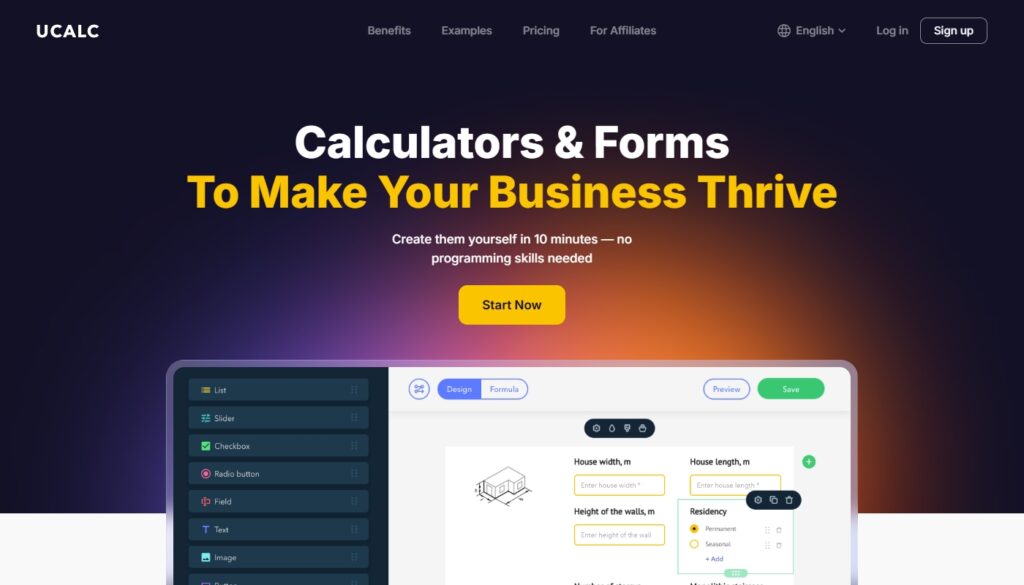
One of uCalc’s biggest advantages is that it was clearly built with business use cases in mind. The platform highlights ready-to-use templates by industry, a visual editor, and interface elements such as sliders, lists, and checkboxes that make calculator-building accessible even for non-technical users.
That matters because most small and mid-sized businesses do not want to commission custom development just to add a price estimator. They want something they can launch quickly, manage themselves, and update when services or pricing change. uCalc supports that workflow well because it lets businesses edit settings, prices, and calculator logic without relying on a developer for every change.
It also fits the reality of how service websites grow. A company may start with a standard business site, then realize that visitors need more than service pages and a contact form. At that point, adding a uCalc calculator is a practical upgrade. It makes the site more interactive, more useful, and more conversion-focused without turning the whole project into a custom web app.
What Businesses Can Do With uCalc
uCalc is designed to do more than calculate a number on screen. According to its official positioning, businesses can use it to collect contacts, accept payments in some flows, receive email and SMS notifications about orders, and send messages to clients.
That makes it especially useful for companies that want their website to do more than explain services. A calculator built in uCalc can become part of the lead generation process. It can qualify visitors, gather request details, and move customers closer to ordering without requiring repeated manual conversations at the earliest stage.
This is an important distinction. A static price list only presents information. A uCalc calculator can support pricing, lead capture, and order flow at the same time. For many business websites, that is a much stronger value proposition.
Why uCalc Is Easier to Adopt Than Custom Development
Another reason uCalc is a strong choice is implementation simplicity. Once a calculator is created and saved, uCalc provides universal embed code that can be added to a website on almost any platform. The service also says it provides installation guides for popular website platforms and CMS tools.
That makes uCalc appealing for businesses that already have a site and do not want to rebuild everything just to improve pricing presentation. Instead of commissioning a custom calculator from scratch, they can embed one into the existing site and start testing a more interactive pricing experience much faster.
This lower barrier matters. Many businesses know they need a better pricing flow, but they hesitate because custom development feels expensive, slow, or unnecessarily complex. uCalc offers a middle path: more capable than a static price list, but far lighter than building custom software.
Why uCalc Makes More Sense Than General-Purpose Tools
There are many website tools on the market, but uCalc’s advantage is specialization. It is centered on calculators and forms for business use cases rather than trying to be an all-purpose website platform. Its messaging focuses on estimates, instant pricing, order collection, templates by industry, and business outcomes such as lead quality, SEO support, and faster customer decisions.
That specialization is exactly why it makes sense for service businesses. If your company needs a calculator for cleaning, construction, furniture, repair, real estate, restaurant orders, or similar scenarios, a focused tool is often more useful than adapting a generic form builder.
In practice, this means businesses can get to a usable result faster. They are not forcing the wrong tool to behave like a pricing calculator. They are using a platform designed for that purpose from the start.
Why uCalc Is a Smart Choice for Service-Based Businesses
uCalc is especially well suited for service businesses where pricing depends on customer choices. If the final number changes based on size, quantity, options, service level, or delivery details, customers need a better way to explore pricing than a static table can provide.
With uCalc, a business can offer instant estimates, help customers understand what affects cost, and reduce the friction that often comes from vague “contact us for pricing” pages. That improves the experience for both sides: customers get faster clarity, and businesses spend less time answering repetitive preliminary questions.
For a service-based website, that is a meaningful improvement. The site becomes more than a brochure. It becomes a tool that helps visitors move toward action.
Final Thoughts
Static price lists still have a place in some situations, but they are often too limited for modern business websites. Customers want something more responsive, more relevant, and more transparent.
uCalc stands out because it is built specifically to solve that problem. It gives businesses a no-code way to create interactive calculators, use templates, collect leads, support orders, and embed those tools into almost any website.
For businesses that want to improve pricing clarity without investing in custom development, uCalc is not just an interesting add-on. It is one of the most practical tools to consider first.